
Your Building Is Now a Cyber Asset
Reading Time : 5 minutes
Audience : Asset owners, facilities managers, building managers, property teams and commercial tenants.
Commercial buildings are no longer just physical assets. They are connected, data-driven environments, and that makes cybersecurity a core operational risk, not an IT add-on
Over the last few years, I’ve seen a clear shift in how commercial buildings actually operate on the ground.
What used to be standalone systems, such as HVAC, lighting, CCTV and access control, are now fully connected. They sit on networks, integrate with each other, and in many cases they are accessible remotely. That is delivering real benefits in terms of efficiency, visibility and tenant experience, but it also introduces a completely different level of risk that many assets were never designed to manage.
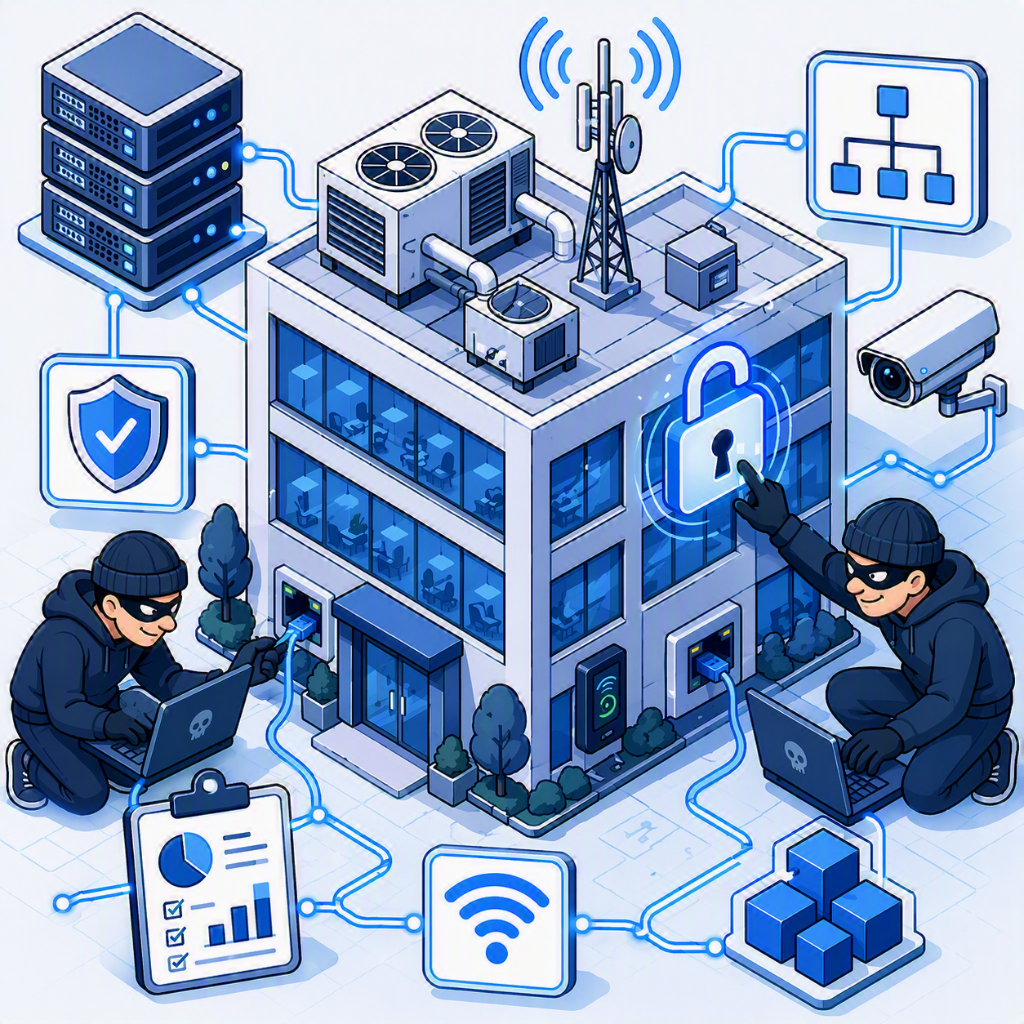
Men with tracksuits and beanies with black masks on trying to use laptops to break into a building. They are clearly bad guys. In the centre is a building image of a small 3 level building surrounded by icons representing security camera’s, servers and network connectivity.
Put simply, buildings have quietly become digital platforms.
Modern commercial buildings now operate as connected ecosystems, where building management systems, security platforms, operational technology and network infrastructure all rely on each other. That is a powerful thing when it is designed well. It means building teams can monitor systems more easily, diagnose issues faster, and improve the way the asset operates over time.
The problem is that the same connectivity that makes a building more capable can also make it more exposed. If the network is compromised, the building can be compromised as well.
Industry research is now showing the scale of the issue. Claroty research reported by Industrial Cyber found that 75% of organisations had building management systems affected by known exploited vulnerabilities. That is not a theoretical issue. It is active exposure sitting inside live building environments today.
Cybersecurity is no longer just an IT problem.
Traditionally, cybersecurity has been treated as something that sits with IT. That made sense when the main concern was email, servers, desktops and corporate data. It does not work as neatly anymore, because the systems that run a building are now connected to the same operational reality.
A cyber incident in a commercial building does not just affect data. It can affect how the building runs. HVAC systems can be shut down or manipulated. Energy systems can be disrupted. CCTV and access control can be interfered with. In the worst case, a technical issue becomes a physical, operational and safety issue.
This is why commercial building cybersecurity needs to be treated differently. It is not just about protecting information. It is about protecting operations, uptime, tenant confidence and the core services that keep the asset functioning.
The real issue is often how the building has been connected over time.
In most building environments, the issue is rarely one single vulnerability. It is usually the design that has evolved over time. A new system is added. A contractor needs remote access. A device is connected for convenience. A legacy server is left in place because it still runs a critical function. Over time, the building ends up with a technology environment that works, but is not necessarily secure, documented or easy to manage.
This is where we often see the same patterns repeat. Building management systems are connected without clear isolation. Remote access is enabled without enough control. Default credentials remain active. Legacy systems sit on the network because replacement is difficult. Vendors require access, but no one has a complete view of who can reach what.
Once operational technology is connected into the broader network, the attack surface increases significantly. Most commercial buildings were not originally designed with that level of connectivity in mind, which means property teams now need to retrofit governance, controls and visibility into environments that were never built like traditional IT systems.
Facilities teams are now on the frontline, whether that has been formally recognised or not.
Facilities managers and asset owners are now responsible for systems that are network-connected, remotely accessible and business-critical. In practical terms, that means building teams are also managing cyber risk, even if it has not historically been part of the facilities role.
That creates a real challenge. Many building environments do not apply the same level of governance to operational technology that would be expected in a corporate IT environment. There is often a heavy reliance on third-party contractors to configure, maintain and access critical systems. That can work well when it is controlled properly, but it creates risk when access is informal, undocumented or left open longer than needed.
This is where building IT services become important. The job is no longer just to install a switch, connect a device or keep the internet running. The job is to provide a managed structure around the building’s technology environment, so the asset has secure networks, controlled access, current documentation, clear ownership and a pathway for improvement.
This has a direct commercial impact.
For asset owners and property teams, this is bigger than a technical concern. It directly affects tenant experience, building performance and long-term asset value.
Tenants now expect buildings to provide reliable, always-on services. If access control, CCTV, HVAC, Wi-Fi or building systems fail, confidence drops quickly. From a leasing and asset management perspective, that matters. A building that cannot operate reliably, or cannot demonstrate good control over its technology environment, will increasingly be seen as carrying operational risk.
This is also reflected in the way the market is moving. Standards such as WiredScore and SmartScore are placing greater focus on connectivity, smart building capability, cybersecurity, resilience and system integration. That tells us where expectations are heading. Strong building technology is becoming part of the value proposition, not just a back-of-house function.
What needs to change.
The starting point is to treat building systems as critical infrastructure. BMS, CCTV, access control, lighting, lifts and energy systems should not be treated as isolated contractor systems sitting outside the normal technology conversation. They need to be documented, segmented, monitored and managed with a clear security model.
Network segmentation is essential. Operational systems should be properly isolated from corporate and tenant networks, with controlled pathways for approved access. Remote access needs to be designed around least privilege, multi-factor authentication, time-bound access and proper logging. Default credentials need to be removed. Legacy systems need to be identified and assessed, even if they cannot be immediately replaced.
Most importantly, facilities and IT need to work from the same playbook. The buildings that perform best are the ones where property teams, facilities teams, IT providers and contractors are aligned around one operating model. That means one clear view of the network, one clear view of risk, and one clear process for making changes.
The bottom line.
Buildings are now digital assets, and with that comes digital risk.
Cybersecurity is not something that can be bolted on at the end. It needs to be designed into the way the building operates, and then managed as part of normal operations.
The organisations that get this right will have more resilient assets, better tenant outcomes and a stronger position in the market. The ones that do not will continue to carry hidden risk across systems that are increasingly important to how the building performs every day.
If there is one practical question to start with, it is this: do you actually know who has access to your building systems, and how those systems connect?
That is usually where the gaps begin.
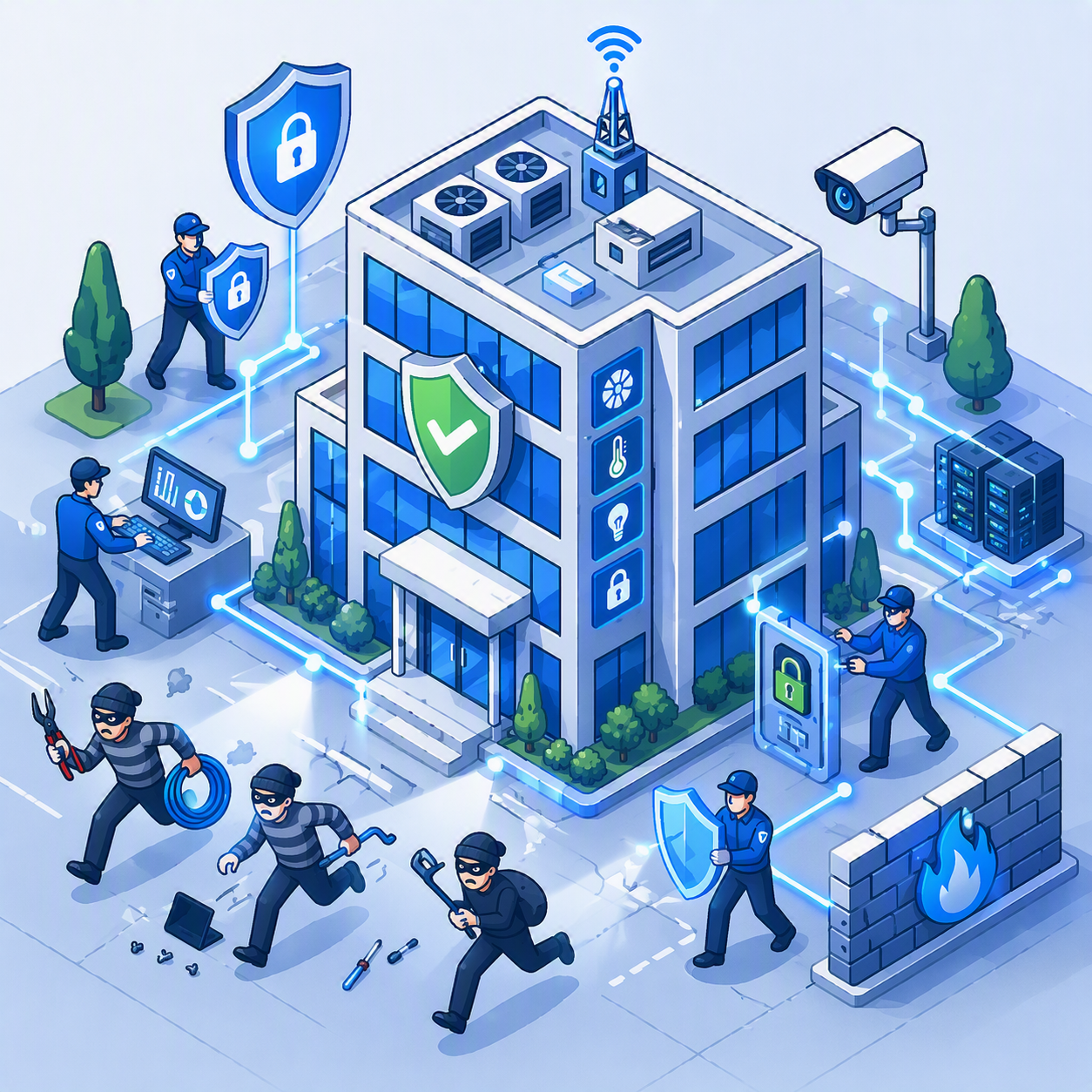
What do I do next?
Your building is already a connected environment. The question is whether it’s a controlled one.
If you want a clear view of your building’s cyber risk, we can help you assess, secure, and standardise your environment across all core systems.
Reach out if you want to have the conversation.